What is Artificial Intelligence (AI)? A Simple Guide for Everyone
Published: 22 Oct 2026
Artificial intelligence, or AI, is a technology that lets machines think, learn, and make decisions like people. AI is used everywhere these days, from online shopping and smartphone apps to space travel and medical treatment. It enables us to develop more intelligent systems that are quick, precise, and effective.
This article will cover the basic definition, types, history, applications, advantages, challenges, and prospects of artificial intelligence. Beginners are able to understand this instruction, but experts will find it useful because it is extensive enough.
What is Artificial Intelligence [AI]?
Artificial intelligence (AI), also known as machine intelligence or computer intelligence, is a technology that allows computers and machines to perform tasks that usually require human thinking. These tasks include learning from information, solving problems, understanding language, and making decisions. People also use terms like AI technology and intelligent systems when talking about this field. Today, we use artificial intelligence in many everyday tools that help us save time and complete tasks more easily.
Examples of Artificial Intelligence
- Voice Assistants: Tools like Siri and Google Assistant follow voice commands, answer questions, and help users perform everyday tasks.
- Chatbots: Customer support chatbots answer common questions and help people find information quickly.
- Recommendation Systems: Platforms like YouTube and Netflix suggest videos and movies based on users’ interests and viewing habits.
- Self-Driving Cars: These vehicles use sensors and computer systems to identify roads, recognize obstacles, and help navigate traffic.
- Facial Recognition: Smartphones use this technology to recognize a user’s face and unlock the device.
- Language Translation: Tools like Google Translate help people understand text and communicate in different languages.
- Email Spam Filters: Email services identify suspicious messages and move unwanted emails into the spam folder.
History of Artificial Intelligence [AI]
Artificial intelligence originated with the assumption that machines could be programmed to think like humans. In the 1950s, British mathematician Alan Turing proposed the “Turing Test” to assess a machine’s potential to exhibit human-like intelligence. This marked the beginning of AI as a field of research. The phrase “Artificial Intelligence” was first formally used in 1956 at the Dartmouth Conference, where researchers addressed the development of robots capable of learning and reasoning.
In the early years, the emphasis was on playing games like chess and solving easy problems. AI grew in the 1980s thanks to “expert systems,” which made judgments based on stored information. But for many years, advancement was hindered by a lack of computational capacity. AI development was revitalized in the 2000s thanks to big data, advanced computers, and sophisticated algorithms. AI is already an essential component of modern life, powering voice assistants, self-driving cars, medical diagnostics, and space exploration.
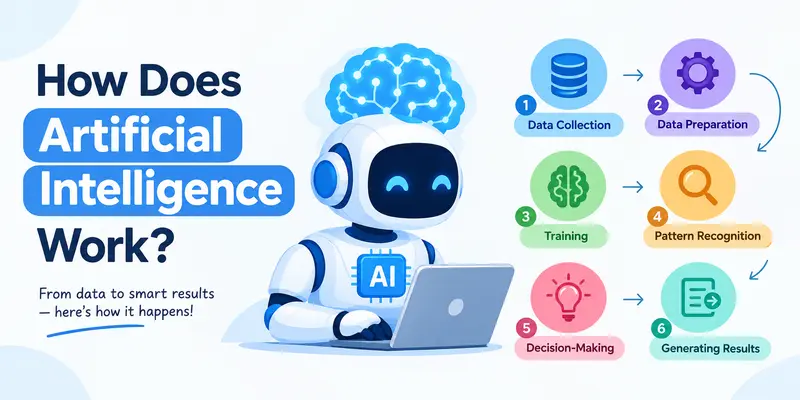
How Does Artificial Intelligence Work?
Now that you understand what artificial intelligence is, you might be wondering how it actually works. Don’t worry! This section will guide you through the process step by step in simple, easy-to-understand language.
- Data Collection: First, an AI system collects information from different sources. This information can include text, images, videos, and other types of data.
- Data Preparation: Next, the system organizes and cleans the collected data. This step helps the system work with useful information and identify meaningful patterns.
- Training: During this step, the AI system learns from examples in the data. It studies different patterns and relationships to improve its ability to perform specific tasks.
- Pattern Recognition: After learning from the data, the system identifies patterns and similarities. For example, an AI system can learn to recognize the difference between pictures of cats and dogs.
- Decision-Making: The system uses the patterns it has learned to make predictions, choose suitable responses, or solve specific problems based on the information it receives.
- Generating Results: Finally, the AI system provides an output. This output might include an answer to a question, a translated sentence, an identified object, or a personalized recommendation.
In simple terms, artificial intelligence learns from data, recognizes patterns, and uses what it learns to produce results. Different AI systems may follow different processes depending on their purpose and design.
What Does Artificial Intelligence Do?
Artificial intelligence (AI) helps people complete different tasks, solve problems, and save time. It can understand information, recognize patterns, and provide useful results in many areas of daily life.
- Answers Questions: AI answers questions and helps people find useful information.
- Learns from Data: AI studies information and learns patterns to perform tasks better.
- Solves Problems: AI helps people find solutions to different problems.
- Recognizes Images: AI identifies objects, faces, and other details in pictures.
- Understands Language: AI helps computers understand human language and respond to messages.
- Makes Recommendations: AI suggests videos, movies, and products based on people’s interests.
- Automates Tasks: AI performs repetitive tasks and helps people save time.
- Predicts Results: AI uses available data to predict possible outcomes, such as future sales or weather conditions.
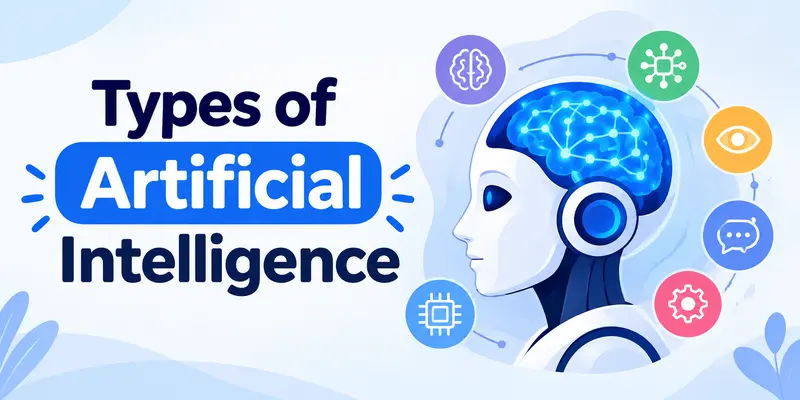
Types of Artificial Intelligence
You might think artificial intelligence is just one thing, but it actually has different types. Each type serves a different purpose. Let’s look at the main types with a simple explanation of each one.
- Narrow AI: This type performs specific tasks, such as answering questions, recognizing faces, or recommending videos.
- General AI: This type would perform different intellectual tasks like a human, but researchers have not yet developed it.
- Super AI: This is a theoretical type of AI that would be more intelligent than humans in almost every area.
- Reactive Machines: These systems respond to current situations but do not store memories of past experiences.
- Limited Memory AI: These systems use past data and information to make decisions, such as self-driving cars.
- Theory of Mind AI: This is a developing concept in which AI could understand human emotions, thoughts, and intentions.
- Self-Aware AI: This is a theoretical type of AI that would have its own awareness and understanding of itself.
- Machine Learning: This type allows computers to learn from data and improve their results without following fixed instructions for every task.
- Deep Learning: This type uses layered computer systems to learn complex patterns from large amounts of data.
- Natural Language Processing (NLP): This technology helps computers understand, process, and respond to human language.
- Computer Vision: This technology helps computers understand images and videos, such as identifying objects in pictures.
- Generative AI: This type creates new content, such as text, images, music, and videos.
- Expert Systems: These systems use stored knowledge and rules to help solve problems or make decisions in specific fields.
- Speech Recognition AI: This technology converts spoken words into text and helps devices understand voice commands.
- Predictive AI: This type studies past data to predict possible future events, trends, or outcomes.
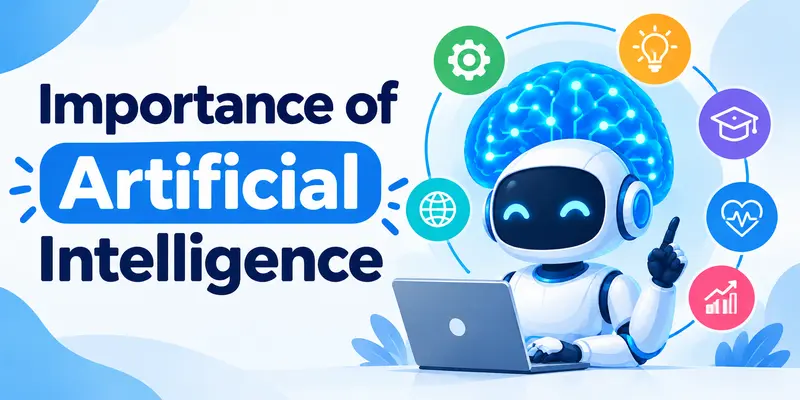
Importance of Artificial Intelligence
Artificial intelligence plays an important role in our daily lives. It helps people complete tasks faster, solve problems, and make better decisions in different fields.
- Saves Time: AI completes many tasks quickly and helps people save valuable time.
- Improves Accuracy: AI can reduce human errors when it performs tasks with suitable data and instructions.
- Increases Productivity: AI helps people complete more work in less time.
- Supports Education: AI helps students learn new topics and understand difficult lessons.
- Improves Healthcare: AI helps healthcare professionals analyze medical information and support patient care.
- Helps Businesses: AI helps businesses understand customers, manage tasks, and improve their services.
- Provides Quick Information: AI helps people find answers and useful information quickly.
- Automates Repetitive Tasks: AI handles routine tasks and allows people to focus on other important work.
- Supports Decision-Making: AI analyzes data and helps people compare options before making decisions.
- Improves Communication: AI helps people translate languages, write messages, and communicate more easily.
Uses of Artificial Intelligence in Everyday Life
Artificial intelligence has become a part of our daily lives. We use it in smartphones, online shopping, education, healthcare, and many other areas. It helps us complete everyday tasks, find information, and save time.
- Smartphones: AI helps phones recognize faces, improve photos, and respond to voice commands.
- Education: Students use AI tools to understand difficult topics, practice lessons, and find answers to questions.
- Healthcare: Doctors use AI tools to study medical images, analyze health information, and support patient care.
- Online Shopping: Shopping websites use AI to recommend products based on customers’ interests and previous purchases.
- Social Media: Social media platforms use AI to suggest posts, recommend videos, and filter unwanted content.
- Navigation: Apps like Google Maps use AI to estimate travel times, suggest routes, and help drivers avoid traffic.
- Entertainment: Platforms like YouTube and Netflix recommend videos, movies, and shows based on viewing habits.
- Communication: AI helps people translate languages, check spelling, and write messages more easily.
- Banking: Banks use AI systems to identify unusual transactions and help detect possible fraud.
- Smart Homes: AI-powered devices help people control lights, adjust temperatures, and manage other home appliances.
Artificial intelligence makes many daily activities easier and faster. Although it offers several benefits, people should use AI tools carefully and protect their personal information.
Advantages of AI
Artificial Intelligence offers many benefits that make tasks easier, faster, and more accurate. Here are some key advantages:
1. Saves Time
AI can complete everything far more quickly than humans, cutting down on hours of labor to a matter of seconds. Both individuals and organizations may work more productively and easily fulfill deadlines thanks to this speed.
2. Works 24/7
AI systems do not need rest or breaks, allowing them to operate continuously. This makes them perfect for roles like customer support, monitoring, and manufacturing.
3. High Accuracy
AI processes vast volumes of data without being weary or distracted by following exact algorithms. This lowers human error and improves the caliber of output.
4. Better Decisions
AI analyzes trends, patterns, and past data to help make smarter choices. Businesses use this ability to improve strategies and predict future outcomes.
5. Automation of Repetitive Tasks
AI can replace repetitive and dull tasks that humans find exhausting. People may now concentrate on more intricate and creative tasks as a result.
6. Personalization
After learning about a user’s interests, AI makes recommendations for pertinent goods, programs, or services. The user experience is improved and made more interesting as a result.
7. Handles Big Data
AI can quickly process and understand huge volumes of information that humans cannot handle easily. This makes it valuable for industries like healthcare, finance, and marketing.
Disadvantages of AI
Despite its many advantages, artificial intelligence has several disadvantages that include employment, expenses, security, and innovation. To use AI ethically and minimize hazards, it’s critical to be aware of these drawbacks:
1. Job Loss
Certain industries may experience unemployment as a result of AI replacing human labor in regular or repetitive tasks. Affected communities face social and economic difficulties as a result.
2. High Cost
Developing and maintaining AI systems requires advanced technology and skilled experts, which can be expensive. Small businesses often struggle to afford these costs.
3. Lack of Creativity
AI cannot think creatively like humans since it only uses the data and rules that are provided to it. This restricts its capacity to generate genuinely novel or inventive concepts.
4. Bias in Decisions
If AI is trained on biased or incomplete data, it can produce unfair or incorrect results. This can harm individuals or groups affected by its decisions.
5. Security Risks
AI systems are at risk of hacking and malicious misuse. This brings up issues with technological abuse, safety, and privacy.
6. Dependency on Technology
Over-reliance on AI can impair people’s ability to solve problems independently. This can eventually weaken human abilities and critical thinking.
7. No Human Judgment
AI lacks emotions, empathy, and moral understanding. This makes it unsuitable for decisions that require compassion or ethical reasoning.
Future of AI
Artificial intelligence appears to have a bright future as technology advances in strength, speed, and intelligence. AI will become more prevalent in sectors including healthcare, education, transportation, and space exploration in the years to come. More sophisticated self-driving automobiles, AI-powered medical diagnoses, and robots that can work alongside people on challenging tasks are all possible.
- Artificial General Intelligence (AGI), or AI that can think and learn like a person in every circumstance, may be another significant advancement. Although technology presents amazing opportunities, it also brings up moral questions around safety, control, and the effect on employment. Strong laws and ethical application are crucial as AI develops to guarantee that society gains from technology while lowering its risks.
Conclusion
We hope you enjoyed reading our article on artificial intelligence and found it helpful in understanding this exciting technology. AI is changing our world in amazing ways, and there’s so much more to explore. If you have any questions, feel free to drop them in the comments below; we’d love to hear from you! To learn more about AI and stay updated with the latest information, stay connected with us for future articles and insights.
Frequently Asked Questions [FAQs]
Here are some common questions and answers to help you understand Artificial Intelligence better.
AI, or Artificial Intelligence, means creating computer systems that can think, learn, and make decisions like humans. It helps machines do tasks such as recognizing speech, solving problems, or understanding images without being told exactly what to do step-by-step.
The four types of AI are:
- Reactive Machines
- Limited Memory
- Theory of Mind
- Self-Aware AI
AI is used in virtual assistants, recommendation systems, self-driving cars, medical diagnosis, and even in chatbots like me.
AI can be harmful if misused, such as spreading misinformation or replacing human jobs. But with proper regulation, it can be very beneficial.
Learning programming languages like Python, researching AI ideas online, and working with AI tools and projects are good places to start.

- Be Respectful
- Stay Relevant
- Stay Positive
- True Feedback
- Encourage Discussion
- Avoid Spamming
- No Fake News
- Don't Copy-Paste
- No Personal Attacks
- Be Respectful
- Stay Relevant
- Stay Positive
- True Feedback
- Encourage Discussion
- Avoid Spamming
- No Fake News
- Don't Copy-Paste
- No Personal Attacks
